

Rolling massager vs massage gun
Both can make a recovery routine feel more manageable—but the pressure, sensation and everyday experience are very different. Here is how to choose without buying more intensity than you actually want.
Neither category is automatically “better” for recovery. Choose according to sensation, target area, portability and how consistently you will use it. Recovery tools may support short-term comfort or mobility, but they do not replace sleep, nutrition, sensible training or clinical care.
Start with the mechanism
Rolling pressure and percussion are not the same.
The easiest way to compare these devices is to ignore the marketing names and look at how they contact the muscle.
Powered rolling massager
Rotating textured rollers travel across the skin while the user guides the device. Pressure is spread across several contact points, producing a continuous rolling sensation rather than repeated strikes.
Percussion massage gun
A motor drives an attachment backwards and forwards to deliver rapid pulses into a smaller area. The sensation, amplitude, speed and available attachments vary substantially between models.
That mechanical difference shapes the whole experience. Rolling devices tend to suit broad passes over larger muscles such as the quadriceps, hamstrings, calves and glutes. Percussion devices tend to suit users who want a more concentrated tapping sensation and the option to change attachment shapes.
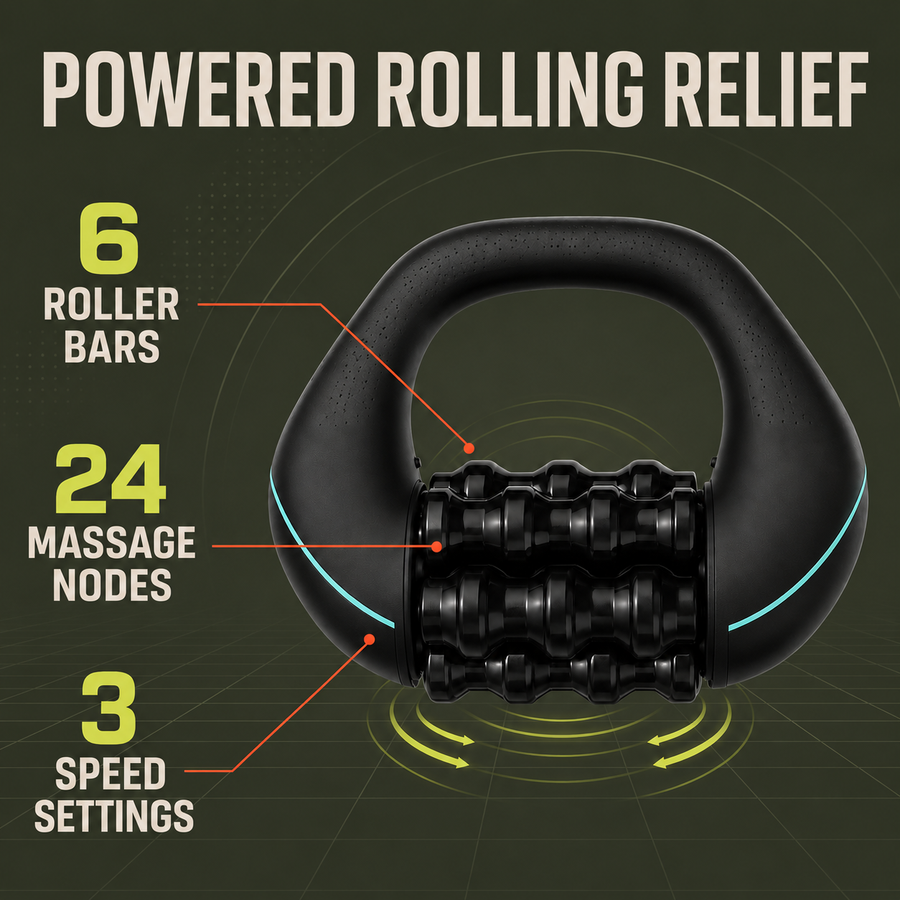
The Orbit™ Mini Recovery Massager sits between a manual massage roller and a conventional massage gun. Its six powered roller bars and 24 textured nodes create moving contact, while three speeds and hand pressure let the user adjust the intensity.
Side-by-side
Rolling massager vs massage gun comparison.
This is a category-level comparison. Individual products can differ, so check the specifications and instructions for the exact device you are considering.
| Factor | Powered rolling massager | Massage gun |
|---|---|---|
| Primary motion | Continuous rotating or rolling contact | Rapid repeated percussion |
| Typical sensation | Smoother and distributed across several contact points | More concentrated and tapping-like |
| Pressure control | Speed plus the pressure applied by your hand | Speed, attachment and pressure applied by your hand |
| Broad muscle areas | Strong fit Easy to guide over quads, hamstrings and calves | Possible, but the head treats a smaller area at once |
| Very focused areas | Less targeted because the contact surface is broader | Strong fit Smaller heads can focus on a defined muscular area |
| Attachments | Usually integrated rollers with no swapping required | Often supplied with several interchangeable heads |
| Learning curve | Generally simple: choose a speed and guide the rollers | Requires choosing a head, speed and appropriate target area |
| Portability | Varies; compact models such as Orbit™ are bag-friendly | Varies from mini devices to larger kits with cases |
| Best suited to | People who value broad, controlled rolling pressure | People who actively prefer focused percussion |
Continue to our Australian roundup: Best Muscle Massagers in Australia: Top Recovery Tools Compared.
Choose by experience
Which recovery tool is more likely to suit you?
Your preferred sensation matters more than chasing the most aggressive specification.
Choose a rolling massager for broad passes
A rolling design may feel more intuitive across larger muscle groups when you want to keep the tool moving rather than hold it over one point.
Choose percussion for focused tapping
A massage gun may suit you if you already know that you enjoy a concentrated percussive sensation and want different attachment shapes.
Choose compact equipment for consistency
The tool that fits your gym bag, charges conveniently and feels easy to use is more likely to become part of your actual routine.
Choose comfort over maximum intensity
More force is not automatically more effective. Start gently, stay on muscular areas and stop if the sensation becomes painful or causes numbness.
What matters most to you?
Choose one priority for a quick category recommendation.
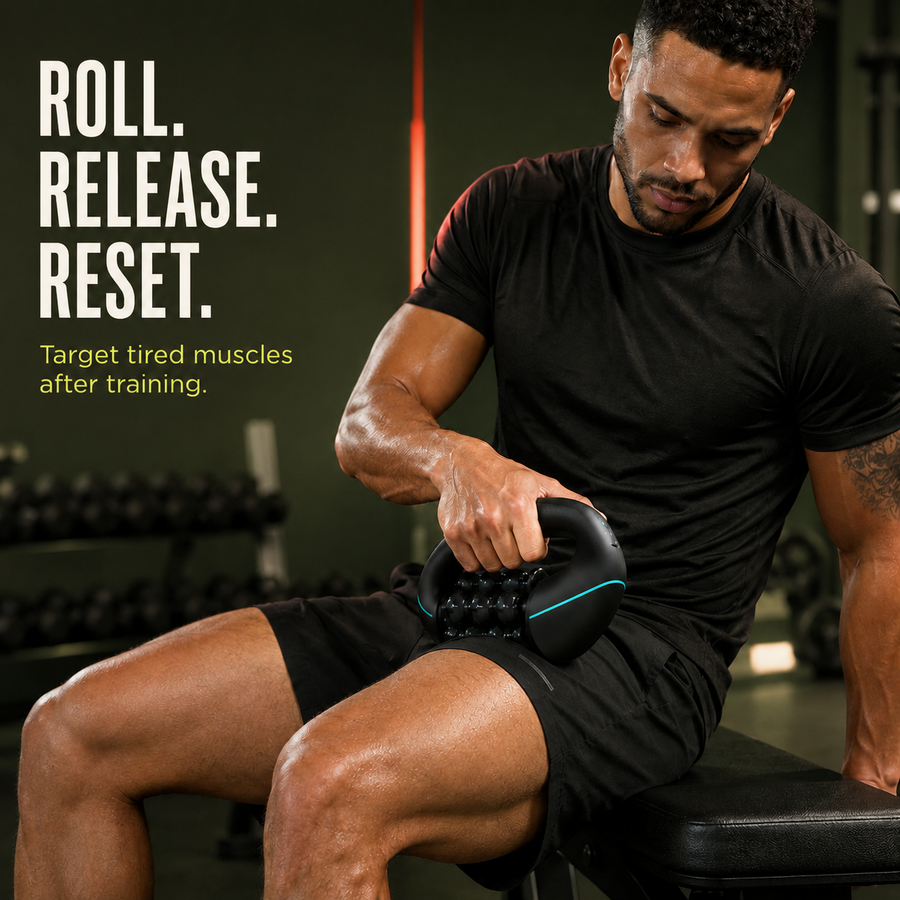
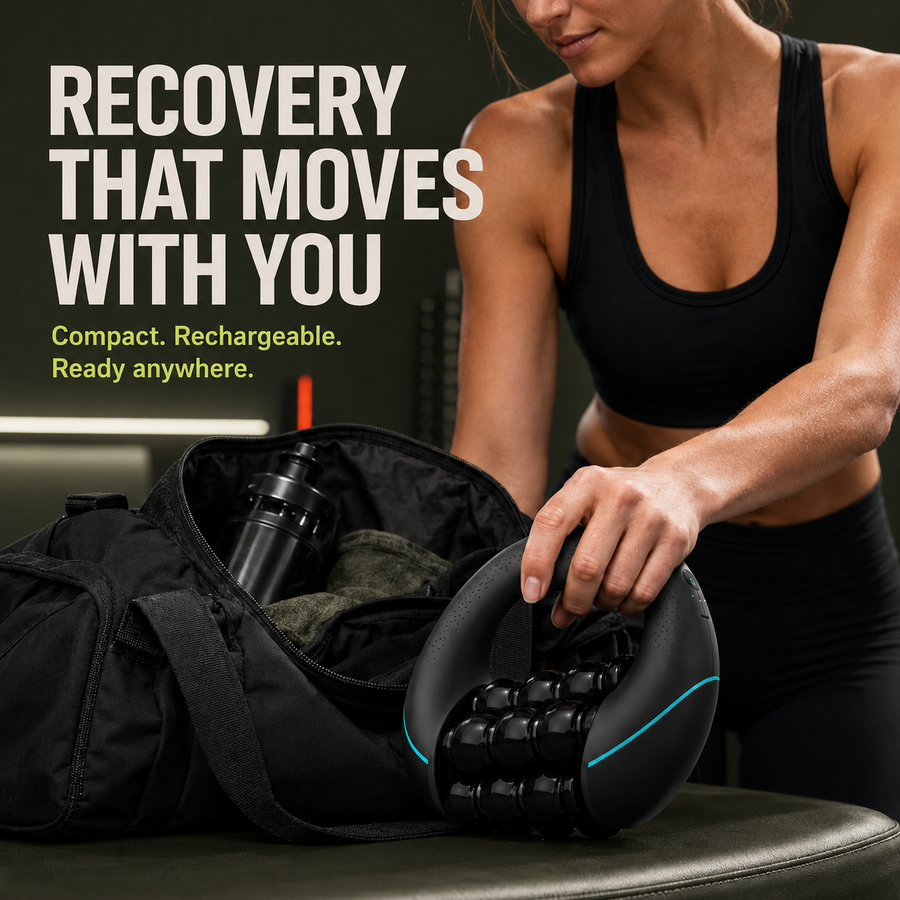
The rolling alternative
Where Orbit™ fits in the comparison.
Orbit™ is designed for people who want powered muscle massage without the repeated striking sensation of a traditional massage gun.
Recover smarter. Move better.
Six textured rotating bars carry 24 massage nodes across the target muscle. Choose one of three speeds, then guide the device using comfortable hand pressure.
- Six powered roller bars
- 24 textured massage nodes
- Three adjustable speeds
- USB-C rechargeable
- Up to four hours cordless use*
- No attachment changes required
*Battery duration is based on product specifications and can vary with speed, use and charging conditions.
Evidence check
What does research say about recovery tools?
Research supports cautious, specific claims—not promises that any handheld tool will “repair” muscle or transform performance.
A 2023 systematic review of massage guns included only 11 studies, with moderate or high risk of bias. It reported possible short-term improvements in flexibility, range of motion and some recovery-related outcomes, but did not support consistent improvements in strength, balance, acceleration, agility or explosive performance. The authors also advised against some pre-activity applications for explosive tasks.
Roller evidence is mixed. A 2023 meta-analysis of five studies involving 151 participants found no significant advantage for foam roller or stick massage across several post-exercise muscle-damage markers. A later systematic review and meta-analysis involving 16 studies reported a modest effect on exercise-induced soreness. Different devices, protocols and study designs make simple “roller wins” or “gun wins” conclusions unreliable.
Most importantly, studies of percussion devices, foam rollers or manual roller sticks do not directly prove the effects of Orbit™. Its powered rotating design should be assessed on its own product experience rather than treated as identical to another category.
Use a recovery device as an optional comfort or mobility tool within a broader routine. Sleep, appropriate training load, hydration and nutrition remain fundamental. Read the 2023 massage-gun systematic review, the 2023 roller meta-analysis, the 2024 foam-rolling review and the sports-massage meta-analysis.
Use recovery devices thoughtfully
Simple safety rules matter.
A muscle massager should feel controlled and tolerable. Pain is not proof that the tool is working.
Do
- Begin on the lowest comfortable setting.
- Use short, moving passes over healthy muscle.
- Reduce hand pressure on tender areas.
- Follow the exact device instructions.
- Seek professional guidance for persistent symptoms.
Avoid
- Bones, joints, the spine and the front or side of the neck.
- Bruised, numb, inflamed or injured areas.
- Open wounds, rashes or recent surgical sites.
- Continuing through sharp pain, tingling or numbness.
- Using a device to self-treat a suspected tear or serious injury.
Ask an appropriately qualified healthcare professional before use if you have a clotting or bleeding condition, take anticoagulants, have reduced sensation, vascular disease, significant osteoporosis, are pregnant, recently had surgery or have another condition that could affect safe use. University of Utah Health also recommends avoiding bony areas, the neck, groin and injured skin, and limiting time on one area.
Questions, answered
Rolling massager vs massage gun FAQs.
Is a rolling massager better than a massage gun?
What is the main difference between a roller massager and a massage gun?
Can I use either tool after a workout?
Do massage guns speed up muscle recovery?
Is Orbit™ a massage gun?
Can I use Orbit™ on my calves and thighs?
Should a muscle massager hurt?
Which option is easier to travel with?
Smooth rolling recovery
Prefer rolling pressure over percussion?
Explore the cordless Orbit™ Mini Recovery Massager and choose the current offer that suits your routine.
Commercial disclosure: On The Nose Co. publishes this comparison and sells the Orbit™ Mini Recovery Massager, so we have a direct commercial interest in purchases made through our links. This article compares product categories using publicly available research and product information; it is not a laboratory or hands-on comparison of every device. Specifications, availability and offers can change. This content provides general information only and is not medical advice.