

Calf recovery after running
A sensible plan for tight or sore calves—from the finish line to your next run—with clear signs that mean stop and get assessed.
Start with the cause
Why calves feel tight after a run
Your gastrocnemius and soleus repeatedly control landing and help propel you forward. When the demand exceeds what they are currently adapted to, the result can feel like heaviness, stiffness or delayed soreness.
Tight calves after running often follow a jump in distance, pace, hills or frequency. A change in surface or footwear can also redistribute load. This does not automatically mean damage—and it does not always mean dehydration. Exercise-associated cramps are considered multifactorial, with fatigue and individual risk factors important; a review cautions against one-size-fits-all advice such as simply drinking more fluids (Miller et al., 2022).
Load changed
More kilometres, faster intervals or extra running days can outpace adaptation.
Terrain changed
Hills, trails and different surfaces alter how your calves absorb and produce force.
Fatigue accumulated
Hard sessions, limited sleep and closely stacked runs can reduce readiness.
Interactive check-in
What does your calf feel like?
Choose the closest description for general guidance. This tool cannot diagnose an injury.
Pick the closest match
If symptoms overlap, follow the more cautious path.
Know the difference
Normal post-run soreness or something else?
Delayed-onset muscle soreness (DOMS) commonly develops after unfamiliar or demanding exercise and is typically most noticeable one to two days later. Pain that begins suddenly during a run needs a different response.
Monitor and recover
- Diffuse ache through the muscle
- Appears later, not with a sudden incident
- Often affects both sides after a hard session
- Improves as you gently warm up
- Your walking pattern remains normal
Stop and assess
- Sharp or pinpoint pain during the run
- A pop, snap or “kicked in the leg” sensation
- Bruising, marked swelling or weakness
- Difficulty walking or pushing onto your toes
- One-sided heat, redness or unexplained swelling
New pain and swelling in one calf—especially with warmth, redness or discolouration—can be a deep vein thrombosis. Seek urgent medical care. Call 000 for chest pain, sudden shortness of breath or coughing blood. See Healthdirect Australia’s DVT guidance.
The practical plan
Your calf recovery timeline after running
Use symptoms—not the clock alone—to guide the next step. Recovery is part of training, not a test of how much discomfort you can tolerate.
MIN
Downshift gradually
Walk easily for a few minutes instead of stopping abruptly. Let breathing and heart rate settle. If pain is sharp or changes your gait, stop the recovery routine and arrange an assessment.
HOUR
Replace what the run used
Eat a normal recovery meal or snack that provides carbohydrate and protein. Drink according to thirst, conditions and your known sweat losses; long or hot runs may require a more deliberate hydration plan.
DAY
Choose comfortable movement
An easy walk and gentle ankle movement can help you feel less stiff. Stretch only to mild tension—never sharp pain. Post-exercise stretching has not shown a clinically important reduction in DOMS (Afonso et al., 2021).
HOURS
Check the trend
DOMS may be more noticeable the next day. Choose rest, walking or genuinely easy training based on your normal function. Prioritise sleep; the Australian Institute of Sport describes sleep as a critical physical and psychological recovery strategy (AIS REST Hub).
RUN
Earn normal loading back
Resume when walking and everyday movement are comfortable and your stride is normal. Start easier than the session that triggered the problem. Persistent or recurring symptoms deserve assessment and a load-management plan.
Optional muscle care
How to massage calves after running
Gentle rolling can be a comfort tool for healthy muscle tissue. It is not a treatment for a tear, tendon injury or blood clot.
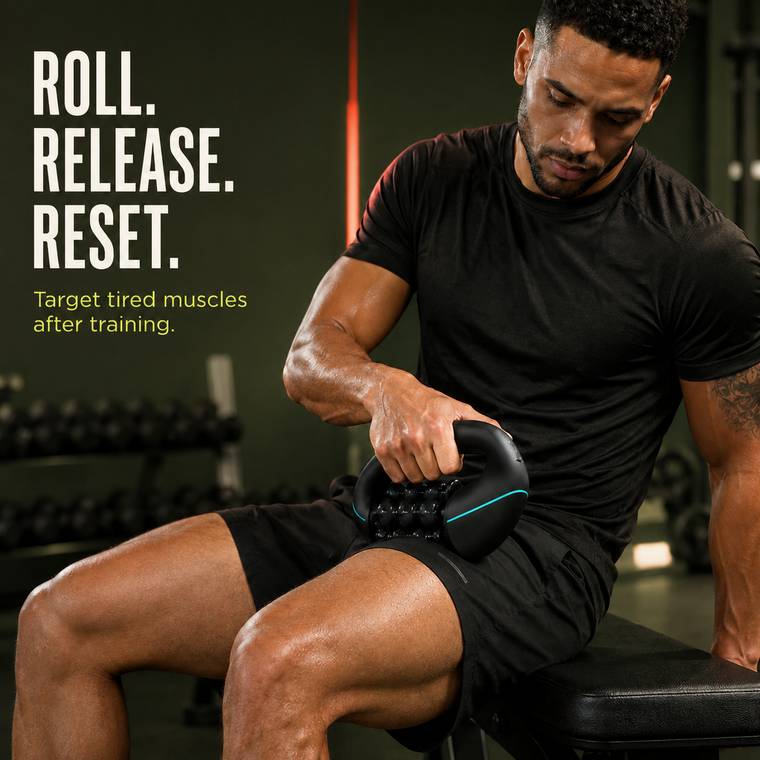
Orbit™ calf protocol
Low pressure. Slow passes. Healthy muscle only.
- Sit comfortably with the calf relaxed and supported.
- Start Orbit™ on its lowest of three speeds.
- Guide the six powered textured rollers over the fleshy calf muscle using broad, slow passes.
- Use light pressure for 30–60 seconds, then reassess. More pain is not more effective.
- Stop if symptoms worsen, feel sharp, tingle or travel.
Research on foam rollers and roller massage is mixed. One 2020 meta-analysis reported acute range-of-motion and possible recovery benefits, while a 2023 review found no significant advantage over no intervention for soreness or other indirect muscle-damage markers. Neither study tested Orbit™ specifically. Treat rolling as an optional comfort and mobility practice—not proof of faster tissue healing. Sources: Skinner et al., 2020 and Medeiros et al., 2023.
Before the next run
A simple return-to-run check
These checks are not medical clearance. They are a practical signal to reduce load or seek help when the calf is not behaving normally.
You can walk briskly without limping or compensating.
Everyday ankle movement feels close to your normal baseline.
A gentle calf raise does not produce sharp pain or obvious weakness.
A sudden pop or snap, bruising, swelling, or difficulty pushing off can indicate a calf strain or Achilles rupture. Seek prompt clinical assessment; NHS guidance notes that rupture can feel like being struck in the back of the leg and may make walking difficult (Cambridge University Hospitals).
Recovery myths
Four ideas worth leaving behind
“Stretching prevents all soreness.”
Stretch if it feels pleasant, but research does not support stretching as a reliable way to prevent DOMS.
“Rolling heals a strain.”
A massager can provide a sensory comfort ritual; it cannot repair torn tissue or replace diagnosis and rehabilitation.
“Soreness proves the run worked.”
Training quality is measured by useful adaptation and consistency—not how sore you can become.
“Tightness should be run through.”
If tightness changes your stride, localises, worsens or returns repeatedly, reduce load and investigate the cause.
Runner questions
Calf recovery FAQs
How long do sore calves last after running?
Should I run with tight calves?
Is walking good for calf recovery?
Should I stretch sore calves after running?
Can I use a rolling massager on my calves?
What causes calf cramps while running?
When should calf pain be checked by a professional?
What is the best way to prevent tight calves after running?
Continue learning
Build the rest of your recovery system
Recovery that fits the routine
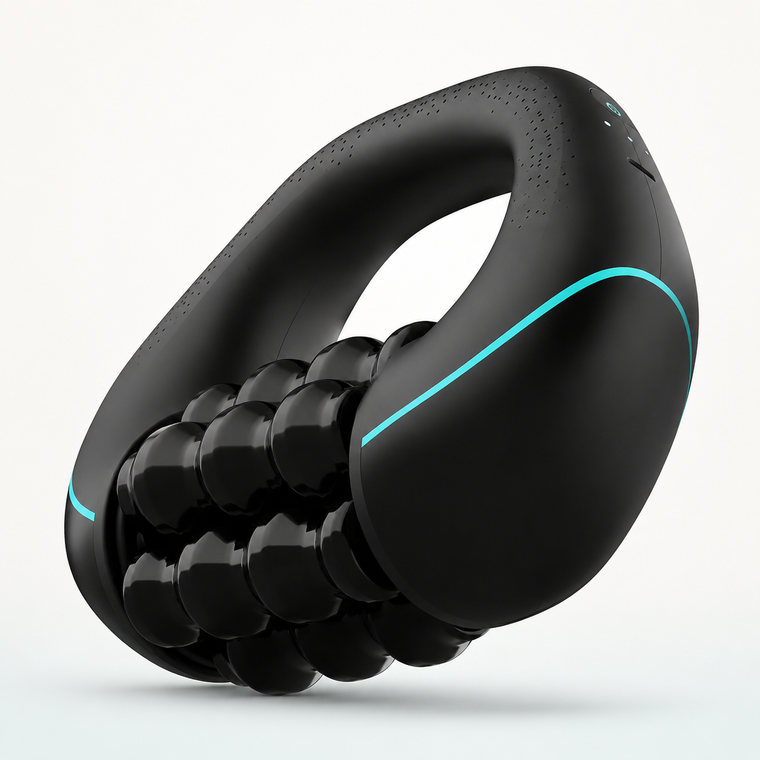
Meet Orbit™
Six powered textured roller bars, 24 massage nodes, three speeds and cordless USB-C charging in a compact format designed for broad muscle areas. Battery life is up to four hours depending on use.