

Magnetic vs Adhesive Nose Strips: Which Is Better?
Both formats support the outer nasal walls, but they differ in application, adhesive coverage, reusability, cost and wearing experience. This guide explains which option may better suit sleep, snoring, running and everyday nasal breathing.

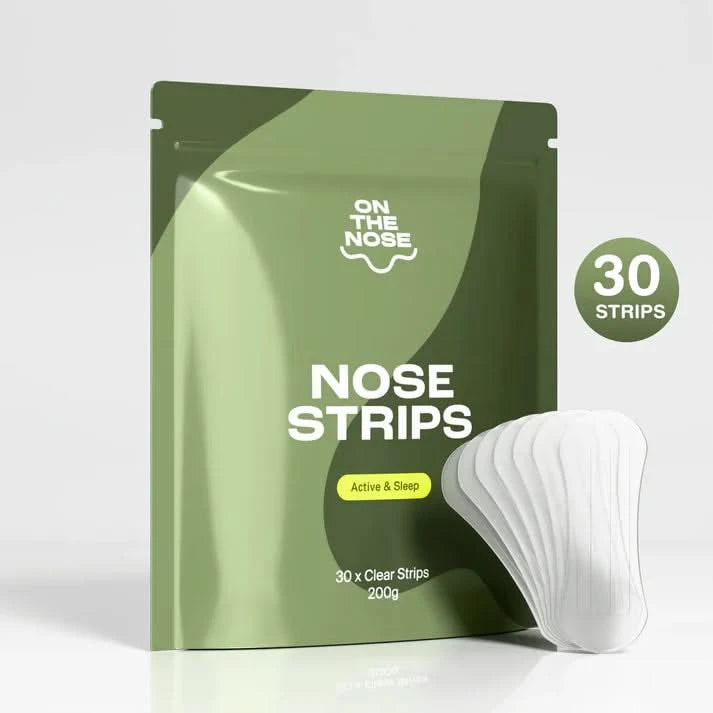
Are magnetic nose strips better than adhesive strips?
Neither format is automatically better for everyone. Magnetic nose strips use two small adhesive side tabs connected to a reusable bridge, making them suitable for people who want a reusable core and less full-width adhesive coverage. Traditional strips use one disposable adhesive strip across the nose and are generally quicker, simpler and easier for first-time users. Both provide temporary external support only while they are correctly attached.
Magnetic vs traditional nose strips: our verdict
The best format depends on whether you value quick application, reusable components, reduced adhesive coverage or a more adjustable external lifting sensation.
You want a reusable bridge
Magnetic systems suit people who prefer two smaller adhesive side tabs, a reusable centre bridge and a more structured external lifting system for sleep, exercise or daily routines.
You want the simplest option
Traditional strips suit people who want a fast, one-piece product that can be applied, worn and discarded without cleaning or reconnecting separate components.
Magnetic and adhesive nose strips compared
| Feature | Magnetic nose strips | Traditional adhesive strips | Best choice |
|---|---|---|---|
| Core design | Reusable external bridge | Single-use flexible strip | Depends on preference |
| Adhesive contact | Two smaller side tabs | One full-width strip | Magnetic |
| Replacement required | Fresh adhesive tabs each wear | Fresh complete strip each wear | Magnetic core reusable |
| Application speed | Tabs must be aligned before attaching bridge | Single strip pressed across the nose | Adhesive |
| Adjustability | Tab position and bridge alignment can be adjusted | Position determined by strip placement | Magnetic |
| Cleaning | Reusable bridge should be kept clean | No reusable component to clean | Adhesive |
| Travel convenience | Carry bridge plus replacement tabs | Carry individually packed strips | Adhesive |
| Visual profile | More noticeable external bridge | Clear strips can be discreet | Adhesive |
| Sleep use | Yes | Yes | Both |
| Running and gym use | Yes, with securely applied tabs | Yes, with sport-suitable adhesive | Both |
| Drug-free external support | Yes | Yes | Both |
Magnetic strips are sometimes described as an alternative to adhesive strips, but they are not completely adhesive-free. The reusable bridge connects to two disposable adhesive tabs that must remain secure on the outer nasal walls.
How do magnetic and adhesive nose strips work?
Both formats are external nasal dilators. They are designed to support the flexible tissue around the nostrils and nasal-valve area, which can narrow during inhalation.
The main difference is how each product creates the external lifting force.
Magnetic nasal strips
A fresh adhesive tab is placed on each outer nasal wall. The reusable bridge connects to the tabs and applies outward support across the nose.
Because the bridge is separate from the adhesive, it can be kept and used again. Only the tabs are replaced after each wear.
- Reusable central bridge.
- Smaller adhesive contact areas.
- Adjustable tab placement.
- Suitable for several routines.
- Fresh tabs are still required.
- More components to position.
- Bridge must be stored safely.
- More visible than a clear strip.
Traditional adhesive nose strips
A flexible strip is placed directly across the lower bridge of the nose. Its bands attempt to return to their original shape, creating a gentle lifting force on both sides.
The entire strip is discarded after use, making this the simpler option for people who do not want to clean, align or store a reusable component.
- Fast one-piece application.
- No reusable component to clean.
- Clear and black options.
- Easy to pack for travel.
- Entire product is single-use.
- Adhesive spans the bridge.
- Cannot be repositioned repeatedly.
- Fit depends on strip size.

Do magnetic strips open the nose more?
Magnetic systems can feel stronger or more adjustable because their side tabs and bridge apply outward support differently from a conventional flexible strip.
That does not mean a magnetic system will always produce a better result. Nose shape, tab position, bridge fit, adhesive security and individual comfort all affect the experience.
View the Magnetic SystemWhich option uses less adhesive?
Magnetic nose strips usually place adhesive on two smaller areas beside the nostrils. Traditional strips place adhesive across most or all of the strip where it contacts the bridge and sides of the nose.
Smaller contact areas may appeal to some people, but they do not guarantee that the system will suit sensitive skin. Each magnetic tab must remain secure enough to support the reusable bridge.
Skin preparation
Both systems require skin that is free from oil, moisturiser, sunscreen, makeup, sweat and moisture.
Contact area
Magnetic systems use two side tabs, while conventional strips adhere across a wider section of the nose.
Removal
Remove the magnetic bridge first, then slowly remove each tab. Traditional strips should also be loosened gradually.
Skin sensitivity
Patch-test where appropriate and stop use if persistent redness, pain, itching or irritation develops.
Placement
Incorrectly placed magnetic tabs can create uneven tension. Traditional strips may provide limited lift when placed too high.
Repositioning
Repeatedly lifting adhesive tabs or strips can reduce adhesion and increase the likelihood of the product coming loose.
Important distinction: magnetic nasal strips are not adhesive-free. The magnetic part is the reusable connecting bridge; the two disposable tabs still attach directly to the skin.
Which type costs less over time?
A magnetic system normally has a higher initial cost because it includes a reusable bridge. After that, users purchase replacement adhesive tabs.
Traditional strips generally have a lower entry cost but require a complete new strip for every wear.
The better-value option depends on local pricing, how often you wear the product and whether the magnetic bridge remains in good condition. Compare the current Magnetic Nasal Strip system , Magnetic Tab Refills and traditional nose-strip packs before deciding.
Which is better for sleep?
Both formats can be used during sleep when correctly fitted and comfortable.
Traditional strips are often easier for first-time users because they require only one placement step. Magnetic strips may suit sleepers who want smaller adhesive contact areas or a reusable bridge.
Neither format can address every cause of snoring. They are most relevant when restricted nasal airflow contributes to the sound. Compare sleep-specific options in Best Nose Strips for Sleep and Best Nose Strips for Snoring .
Which is better for running and exercise?
Traditional sport strips provide a lightweight, one-piece option. Magnetic systems offer a reusable bridge and may provide a more structured external lifting sensation.
Heavy sweat can affect the adhesive used by either format. Apply the strip or tabs before warming up, after thoroughly cleaning and drying the skin.
Nose strips may improve the sensation of nasal openness, but they should not be promoted as guaranteed to increase oxygen uptake, running speed or athletic endurance. Explore the full comparison in Best Nose Strips for Running .
How to apply magnetic nasal strips
Clean both sides of the nose
Remove facial oil, skincare, sunscreen, makeup, sweat and moisture.
Dry the skin completely
Adhesive tabs may lift prematurely when applied to damp skin.
Apply one fresh tab on each side
Position the tabs evenly on the outer nasal walls and press firmly.
Attach the reusable bridge
Align both magnetic connection points and allow the bridge to connect securely.
Check the tension
The bridge should feel balanced and supportive without causing pain or excessive pulling.
Remove in the correct order
Detach the reusable bridge first, then slowly remove and discard the adhesive tabs.

How to apply traditional adhesive nose strips
Wash and dry the nose
Remove products and moisture that could interfere with adhesion.
Remove the backing
Avoid touching the adhesive more than necessary.
Position across the lower bridge
Place the strip above the flare of the nostrils rather than high on the bony bridge.
Press the centre and both ends
Smooth the strip firmly from the middle outward.
Allow the adhesive to settle
Apply before bed or exercise rather than after the skin becomes damp.
Remove slowly
Loosen the edges gently and use warm water when needed.
Which type should you choose?
What does the science say?
Research usually discusses external nasal dilators as a broad category rather than directly comparing modern magnetic bridges with traditional adhesive strips.
External dilators can increase dimensions around the nasal-valve area and reduce nasal resistance in some users. The amount of improvement varies by anatomy, product design and placement.
Evidence does not establish that one external format is universally superior. It also does not support using either type as a replacement for the diagnosis or treatment of obstructive sleep apnoea.
Nose strips do not treat sleep apnoea
Seek professional assessment for breathing pauses, choking, gasping, loud persistent snoring, morning headaches, severe daytime sleepiness or difficulty staying awake.
Learn more in Do Nose Strips Actually Work? and How Do Nose Strips Work? The Science Explained .
Final verdict
Magnetic nose strips are best for people who value a reusable central bridge, smaller adhesive side tabs and a more adjustable external system.
Traditional adhesive strips are best for people who prefer speed, simplicity, discreet clear options and a one-piece product that requires no cleaning or storage.
Both formats can support the outer nasal walls during sleep, sport and everyday routines. Neither is guaranteed to work better for every nose, and both depend on correct positioning, clean skin and secure adhesion.
Frequently asked questions
Are magnetic nose strips better than adhesive strips?
Neither is automatically better. Magnetic strips offer a reusable bridge and smaller adhesive tabs, while traditional strips provide faster one-piece application.
Do magnetic nose strips still use adhesive?
Yes. Two disposable adhesive tabs attach to the outer nasal walls. The reusable magnetic bridge connects to those tabs.
Are magnetic nasal strips reusable?
The magnetic bridge is reusable. The adhesive side tabs are single-use and should be replaced after every wear.
Can traditional adhesive nose strips be reused?
Traditional strips are generally designed for one application. Reusing one may result in poor adhesion and reduced external support.
Which type is better for sensitive skin?
Magnetic systems use smaller adhesive contact areas, but the tabs may still irritate sensitive skin. Skin responses vary, so follow the directions and stop use if irritation develops.
Which nose strip is easier to apply?
Traditional adhesive strips are usually easier because they use one piece. Magnetic systems require two tabs to be positioned before attaching the bridge.
Which is better for sleep?
Both can be used for sleep. Traditional strips offer simplicity, while magnetic strips may suit people who prefer a reusable bridge and smaller adhesive areas.
Which is better for running?
Both can be used during running when applied securely. Traditional strips are lighter and simpler, while magnetic systems offer a reusable bridge and different lifting sensation.
Do magnetic strips fall off when you sweat?
Sweat, sunscreen, oil and moisture may weaken the adhesive tabs. Apply them to clean, fully dry skin before exercising.
Do adhesive nose strips damage the skin?
Many people tolerate them well, but irritation can occur. Avoid broken skin, remove strips slowly and discontinue use if persistent redness or pain develops.
Do magnetic nose strips stop snoring?
They may help when restricted nasal airflow contributes to snoring. They cannot address every cause of snoring or treat obstructive sleep apnoea.
Can magnetic strips fix a deviated septum?
No. They may provide temporary external support but cannot straighten the septum or permanently correct structural obstruction.
Can I use magnetic tabs without the bridge?
The tabs are designed to connect with the compatible magnetic bridge. On their own, they do not provide the intended external lifting action.
How often should magnetic tabs be replaced?
Use a fresh compatible pair for each application. Reusing tabs may reduce hygiene, adhesion and comfort.
Do either type treat sleep apnoea?
No. Magnetic and traditional nose strips are not treatments for obstructive sleep apnoea.
Research and product sources
- Dinardi RR, et al. External nasal dilators: definition, background and current uses. View the published review .
- Griffin JW, et al. Physiologic effects of an external nasal dilator. View the study .
- Camacho M, et al. Nasal dilators for snoring and obstructive sleep apnoea: systematic review and meta-analysis. View the research .
- On The Nose Co. Magnetic Nasal Strips product information. View the product .
- On The Nose Co. Active and Sleep Nose Strips product information. View the product .