

Muscle massager: before or after your workout?
The short answer is “either”—but the goal, pressure and routine should change depending on which side of training you are on.
The simple verdict
Timing changes the purpose—not the basic safety rules
Think “prepare” before exercise and “comfort” after exercise. Neither use replaces a proper warm-up, cooldown, sleep, nutrition or injury assessment.
Brief preparation
Use light rolling when you want a muscle area to feel less stiff before movement.
- Short, broad passes on healthy muscle
- Low intensity and no lingering on tender points
- Follow with dynamic movement and warm-up sets
- Do not expect automatic strength or speed gains
Comfort and downshift
Use comfortable rolling if it helps you relax or move more freely after training.
- Let breathing and heart rate settle first
- Relax and support the target muscle
- Stop if discomfort becomes sharp or increases
- Do not treat rolling as proof of faster healing
Interactive timing tool
What are you trying to achieve?
Choose your goal for a practical recommendation. This is general guidance, not medical advice.
Select your situation
Your symptoms matter more than the clock.
Two different routines
How to use a muscle massager around training
The 3-minute primer
- Choose one or two healthy muscle groups relevant to the session.
- Use the lowest comfortable setting with light pressure.
- Make slow, broad passes for roughly 30–45 seconds per area.
- Stop if you feel sharpness, tingling, numbness or increased discomfort.
- Follow with dynamic movement and progressively loaded warm-up sets.
The 5-minute downshift
- Walk or move easily while breathing settles.
- Support and relax the target muscle.
- Use light-to-moderate, comfortable pressure for 30–60 seconds.
- Avoid bones, joints, tendons, bruises and swollen areas.
- Finish with food, fluids and sleep appropriate to your training.
Where and when
A body-area timing guide
Stay on broad muscle tissue and adjust the routine to the training ahead or just completed.
| Area | Before training | After training | Avoid |
|---|---|---|---|
| Quads | Brief light passes before squats, running or cycling. | Comfortable broad passes after lower-body work. | Kneecap, hip bone, bruises and sharp pain. |
| Hamstrings | Follow rolling with active hinges or leg swings. | Support the leg and keep pressure comfortable. | Back of knee and suspected strains. |
| Calves | Follow with ankle movement and gradual calf loading. | Stay on the fleshy muscle belly. | Achilles tendon, back of knee and swelling. |
| Forearms | Keep it brief before gripping or pulling work. | Use gentle pressure after carries or lifting. | Wrist, elbow, tingling and numb areas. |
| Shoulders | Use only where the device remains controlled. | Pair with comfortable shoulder movement. | Neck, spine, collarbone and joint pain. |
What research supports
The honest evidence on timing
Before exercise, systematic reviews suggest foam rolling can produce an immediate improvement in joint range of motion, but this does not mean it improves every performance measure. A 2020 meta-analysis found an acute ROM benefit, while research on sports massage found no evidence of direct improvements in strength, jump, sprint or endurance performance (Wilke et al., 2020; Davis et al., 2020).
After exercise, massage or rolling may modestly improve flexibility, perceived recovery or soreness for some people. Evidence is mixed and protocols vary. These findings do not establish faster muscle repair and do not test Orbit™ specifically. The most reliable approach is to treat massage as optional support around the basics—not as the main recovery mechanism.
One tool, two purposes
Using Orbit™ before or after training
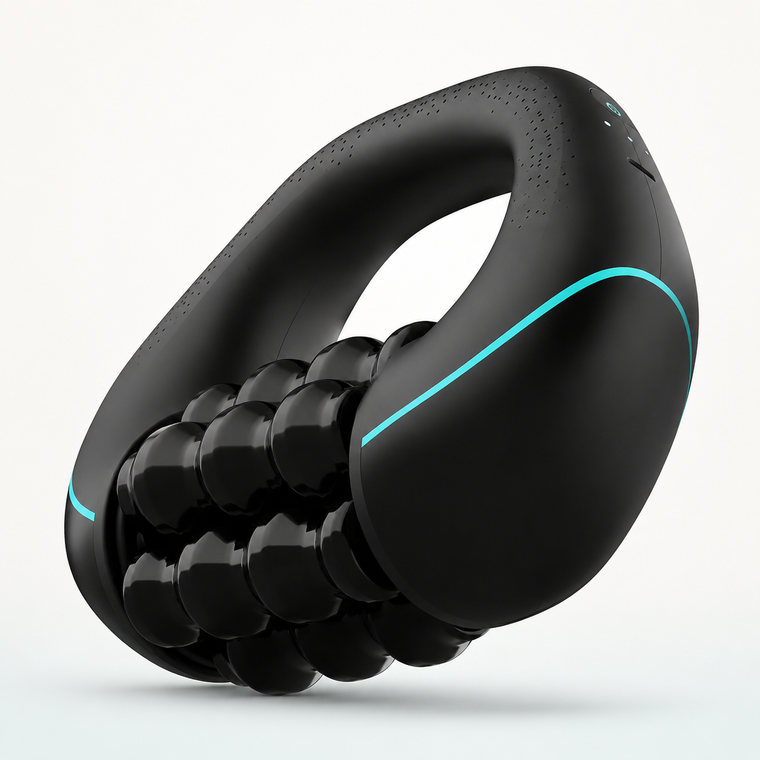
Orbit™ provides smooth powered rolling rather than percussive striking. Start low and let the timing determine your goal.
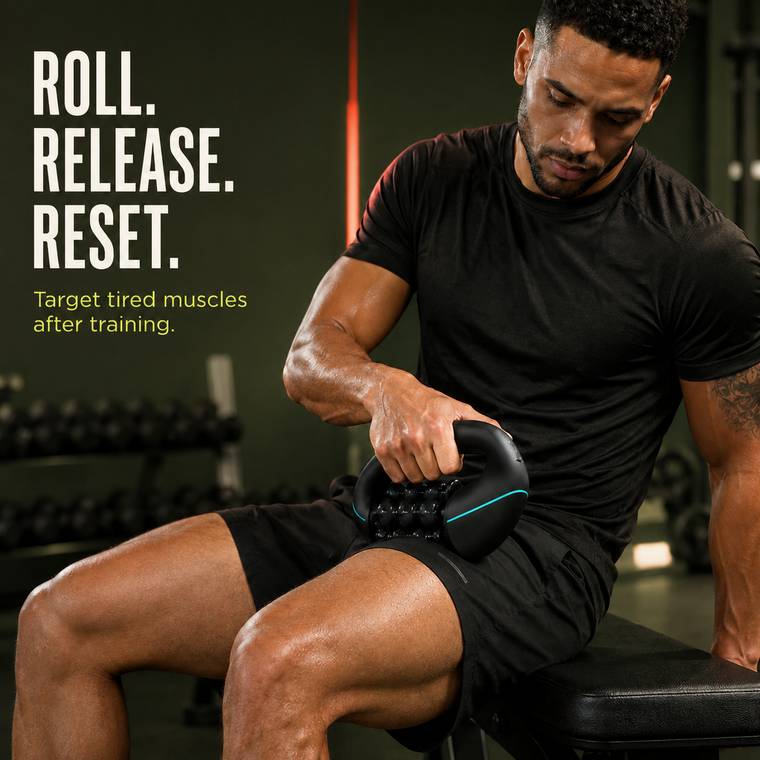
Designed for controlled rolling
Choose the speed. Guide the pressure.
- 6 powered roller barsBroad, smooth contact across muscle.
- 24 massage nodesTextured rolling rather than harsh percussion.
- 3 speed settingsBegin low and adjust for comfort.
- Cordless USB-CUp to four hours depending on use; cable included.
Before training, use Orbit™ to support a feeling of readiness before your real warm-up. After training, use it for comfort and relaxation. Do not use it to numb pain so you can train through an injury.
Common timing mistakes
Four things to avoid
Replacing the warm-up
Rolling cannot prepare skill, coordination or progressive loading. Always follow it with movement specific to the session.
Chasing performance claims
Feeling looser is not the same as becoming stronger, faster or more powerful.
Attacking sore tissue
DOMS does not require punishing pressure. Sensitive tissue often needs a lighter approach, not a harder one.
Masking an injury
Do not roll sharp, swollen, bruised, numb or unstable areas to make training feel possible.
Seek professional care for sudden or severe pain, a pop or snap, significant swelling or bruising, weakness, numbness, inability to bear weight, symptoms that worsen, or pain that repeatedly changes your technique. Do not massage a suspected injury.
Straight answers
Muscle massager timing FAQs
Is it better to use a muscle massager before or after exercise?
How long should I use a massager before a workout?
Can a muscle massager replace warming up?
Does massage improve workout performance?
How soon after a workout can I use a muscle massager?
Can I use a massager on sore muscles the next day?
Should I use high speed before training?
Where should I not use a muscle massager?
Can I use a muscle massager every day?
Continue learning
Build your complete recovery system
Before. After. Wherever you train.
Meet Orbit™
A compact powered roller with six textured roller bars, 24 massage nodes, three speeds and cordless USB-C charging. Battery life is up to four hours depending on speed, pressure and use.