

HYROX recovery: your first 72 hours
A practical plan for the finish line, race night and the next three days—built around the combined demands of running, sleds, carries, lunges and wall balls.
Why recovery feels different
HYROX combines multiple kinds of fatigue
The official format alternates a 1 km run with one functional workout station eight times: 8 km of running and eight stations in total.
That repeated switch between running and loaded work can leave calves, quads, glutes, hamstrings, grip, shoulders and upper back feeling different things at the same time. The current format is confirmed by the official HYROX race overview; station standards and division details can change, so competitors should check the current official rulebook before racing.
Running load
Eight repeated kilometres accumulate impact and calf, quad and hamstring demand.
Heavy force
Sled push and pull challenge legs, trunk, upper body and grip under fatigue.
High repetitions
Lunges, burpees and wall balls create repeated eccentric and concentric work.
Whole-body fatigue
Ergs and carries add cardiovascular, posterior-chain, shoulder and forearm stress.
Interactive recovery check
What feels worst after your race?
Choose the closest match for a recovery emphasis. This tool cannot diagnose an injury.
Choose your main symptom
If symptoms overlap, follow the more cautious result.
Race finish to day three
Your HYROX recovery timeline
This is a decision framework, not a promise that every athlete will be recovered within 72 hours.
MIN
Downshift without stopping abruptly
Walk gently while breathing and heart rate settle. Get out of wet clothing and respond to the venue temperature. Sit or seek event medical support if you feel faint, confused, unusually breathless or unwell.
MIN
Start replacing fluid and energy
Drink according to thirst, conditions and your personal sweat losses. Choose familiar carbohydrate and protein you tolerate well. There is no single drink, ratio or meal that suits every racer.
HOURS
Eat, relax and use comfortable movement
Have a normal balanced meal and continue sensible hydration. Brief walking or gentle mobility may feel better than staying completely still. Avoid turning recovery into another workout.
NIGHT
Protect sleep
Allow a generous sleep opportunity and use a familiar wind-down routine. The Australian Institute of Sport describes sleep as a critical physical and psychological recovery strategy (AIS REST Hub).
HOURS
Check function, not just soreness
Notice your gait, stairs, joint comfort and whether pain is diffuse or pinpoint. Easy walking is reasonable if movement is normal. Skip the celebratory “test workout” when technique is altered.
HOURS
Expect soreness to evolve
Delayed-onset muscle soreness may be more noticeable one or two days after unfamiliar effort. Choose rest or genuinely easy activity. Gentle rolling can be used on healthy muscle if it feels comfortable.
HOURS
Use a return-to-training check
Before intensity, look for normal walking, stairs, bodyweight squat, calf raise and comfortable shoulder movement. Return gradually. If pain is sharp, worsening or changes technique, wait and seek assessment.
Eight stations, different demands
Where post-HYROX soreness may show up
This map is descriptive, not diagnostic. Individual technique, division, training history and race execution change which areas feel most loaded.
SkiErg
Lats, upper back, triceps, trunk and grip.
Sled push
Quads, glutes, calves, trunk and shoulders.
Sled pull
Back, arms, grip, legs and trunk bracing.
Burpee broad jumps
Whole body, with repeated calf, quad, hip and upper-body work.
Rowing
Quads, glutes, hamstrings, trunk, back and arms.
Farmers carry
Grip, forearms, shoulders, trunk and walking musculature.
Sandbag lunges
Quads, glutes, adductors, calves and trunk.
Wall balls
Quads, glutes, shoulders, triceps and trunk.
Optional race-bag recovery
A gentle Orbit™ routine after HYROX
Orbit™ is a comfort and mobility tool for healthy muscle. It is not a treatment for an injury, dehydration, heat illness or rhabdomyolysis.
The broad-muscle circuit
Lowest speed. Light pressure. Slow passes.
- QuadsBroad passes on the front of each thigh.
- HamstringsRelax and support the leg; avoid the back of the knee.
- CalvesStay on the muscle belly, away from Achilles.
- ForearmsUse gentle pressure and stop for tingling or numbness.
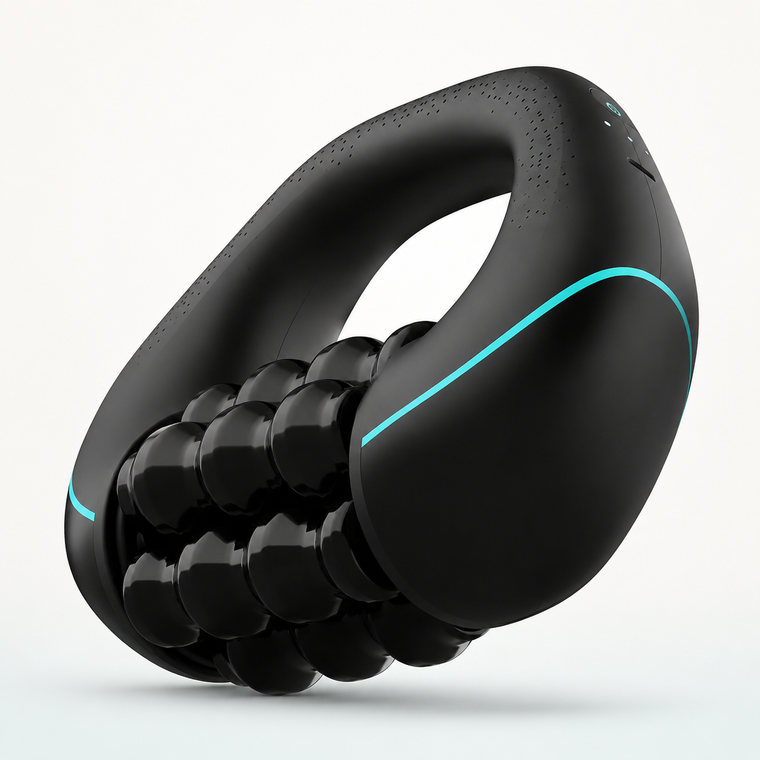
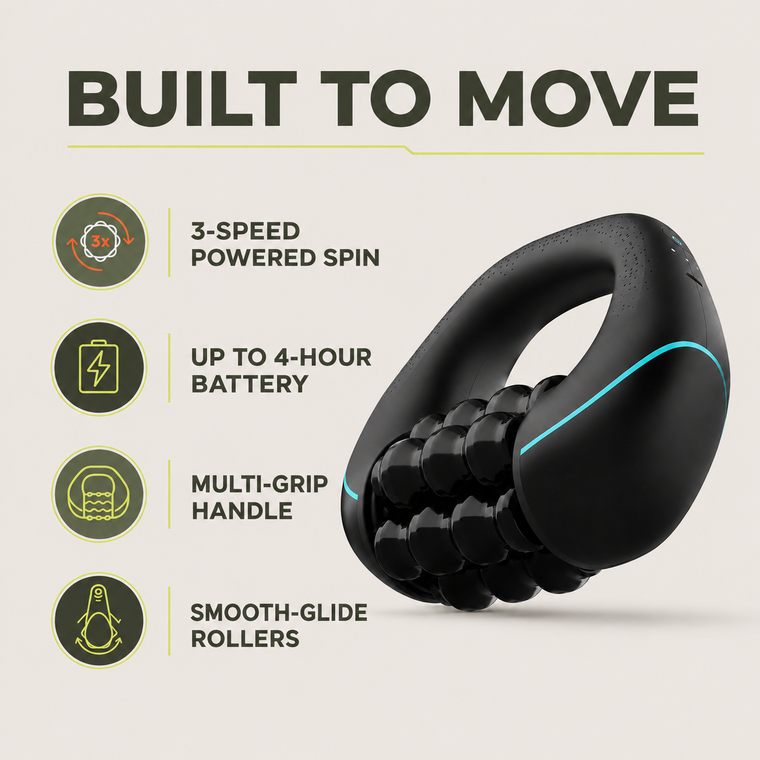
Research on foam rolling and self-myofascial release suggests possible short-term benefits for perceived recovery, flexibility or range of motion, but methods and findings vary. This research did not test Orbit™ and does not prove faster tissue healing. Use the six powered textured roller bars and 24 massage nodes as an optional comfort practice, not a shortcut around food, hydration, sleep or appropriate load management.
Avoid the recovery theatre
Four post-race mistakes
Trying to “flush lactic acid”
The burning sensation during hard work and next-day DOMS are not the same problem. Recovery does not depend on aggressively forcing “toxins” out of muscle.
Rolling as hard as possible
Pain is not proof that massage is working. Aggressive pressure can irritate already sensitive tissue and may hide symptoms that need assessment.
Following a universal hydration number
Needs vary with sweat rate, conditions, body size, duration and what you consumed during the event. Replace deliberately, but do not force excessive fluid.
Repeating intensity the next morning
A hard workout is not a recovery test. Resume intensity when normal movement and technique return—not because exactly 24 hours have passed.
Know when to stop
Post-race warning signs
Severe muscle pain or swelling with marked weakness and dark red, brown, tea- or cola-coloured urine can be signs of rhabdomyolysis. Symptoms may appear hours or days after intense exercise. Healthdirect Australia advises urgent medical attention (rhabdomyolysis guidance).
Seek help for confusion, collapse, chest pain, unusual breathing difficulty, persistent vomiting, severe headache, a sudden pop, inability to bear weight, major swelling, numbness, obvious weakness or pain that is sharp, worsening or highly localised. Do not massage these symptoms.
Straight answers
HYROX recovery FAQs
How long does it take to recover from HYROX?
What should I do immediately after HYROX?
What should I eat after a HYROX race?
Should I train the day after HYROX?
Why are my legs so sore after HYROX?
Should I stretch after HYROX?
Can I use a muscle massager after HYROX?
When can I run again after HYROX?
What are dangerous symptoms after a HYROX race?
Continue your recovery plan
Related On The Nose Co. guides
Compact recovery for training and race travel
Meet Orbit™
Six powered textured roller bars, 24 full-contact massage nodes, three speeds and cordless USB-C charging for broad muscle areas. Battery life is up to four hours depending on speed, pressure and use. Charging cable included.